
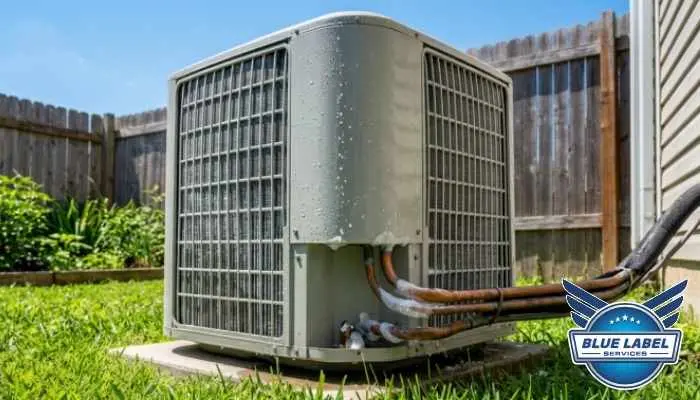
From the techs at Blue Label Services — Cypress, TX
I've lost count of how many calls we run in Cypress every summer that start the same way: "My AC is on, but the house won't cool down — and there's ice on the unit." If you're standing in your yard off Barker Cypress or out in Bridgeland looking at a block of frost on your refrigerant lines, I want to walk you through what's actually happening, because it's not what most folks think.
First thing to understand: an air conditioner should never freeze. Ice is always a symptom, never normal. When I show up to a frozen system, I tell homeowners the same thing every time.
"Your AC will freeze for two reasons. One, it's low on charge. Two, it's low on indoor airflow. In any case, it's best to turn the AC off so it can thaw out and call for service. AC units should not freeze."
That's the whole picture in two sentences. Let me explain why it happens, especially here in Cypress where our summers run long, hot, and brutally humid.
Why ice forms in the first place
Your indoor coil — the evaporator coil — is supposed to stay cold but not freezing. It pulls heat and moisture out of your air. When something disrupts that balance, the coil temperature drops below 32 degrees, the moisture condensing on it freezes instead of draining away, and the ice snowballs. Once it starts, it gets worse fast. The ice blocks airflow, which makes the coil even colder, which makes more ice. By the time you notice warm air at the vents, the coil can be a solid white brick.
The two root causes are airflow and refrigerant.
Low airflow is the one we see most in Cypress, and it's usually a dirty filter. Our pollen, dust, and the sheer amount of run-time these systems get out here clog filters quickly. A choked filter starves the coil of warm return air, and down goes the temperature. Crushed or collapsed ductwork does the same thing — I've crawled through plenty of attics in Fairfield and Towne Lake and found a duct that got stepped on or pinched and slowly froze the system over weeks.
Low refrigerant charge is the other big one, and this is where it gets serious. A system that's low on refrigerant runs at lower pressure, the coil gets too cold, and it ices over. Low charge almost always means a leak somewhere, because these systems are sealed — they don't "use up" refrigerant the way a car burns gas.
What you can do — and what you can't
I'll be straight with you about the homeowner side of this.
"Unfortunately, the only thing a homeowner can do is change the air filter and check for crushed ductwork. Other causes are usually major fixes or require specialized tools, equipment, and licensing. They're usually related to problems with the refrigerant charge."
Quick note while we're here, because the question comes up on almost every call: Freon is actually a trademarked brand name owned by DuPont. What's running through your system is more accurately just called refrigerant. Same idea, more correct term — and handling it requires EPA certification and proper recovery equipment, which is why charge work isn't a DIY job.
So here's your move when you see ice: shut the system off and let it thaw completely. Don't keep running it — frozen systems push liquid refrigerant back toward the compressor, and a compressor is the single most expensive part in your home. Switch the fan to "on" if you want to speed up the thaw, swap that filter, and give us a call.
Keeping it from happening again
Once we get you back up and running, here's a simple rule to protect your system:
Don't run the unit more than 20 degrees below the outdoor temperature, or below 72 degrees — whichever is higher.
On a 100-degree Cypress afternoon, asking your AC to hit 68 is a recipe for a frozen coil and a sky-high bill. Set it reasonably, keep a clean filter in it, and stay on a maintenance schedule so we catch low charge before it ices you out.
If your system's frozen up, turn it off and call Blue Label Services at 832-429-2209. We'll get you cooling again — the right way.